

读懂艺术家 | 广州影像三年展2025——阿梅莉·拉布尔代特
编者按
广州影像三年展2025以 “感知生态学” 为主题,集结全球 25个国家和地区的80 余位影像领域创作者,呈现一场聚焦生态、感知与媒介创新的艺术盛宴。
参展艺术家立足多元文化背景,以摄影、影像装置、数字艺术等丰富媒介,从自然生态、城市生态、人文生态等维度展开创作,用镜头记录环境变迁,以作品探讨人类与自然的共生关系。
这些创作者既是影像艺术的实践者,也是时代议题的回应者。接下来,让我们逐一走近他们,解读其作品背后的创作逻辑与思想内核。
艺术家简介
Artist Biography
阿梅莉·拉布尔代特(生于1974年,特鲁瓦),生活和工作于巴黎。视觉艺术家、学者、摄影师,毕业于南特国立高等美术学院。曾在法国、瑞士、英国、突尼斯、意大利等国际多地举办个展和群展。
她曾获得多项研究与创作资助,包括索尼世界摄影大赛建筑类奖项(2016年)以及法国国家造型艺术中心(Centre National des Arts Plastiques, CNAP)2017年颁发的当代纪实摄影资助。2020年,她入围路易王妃香槟“发现奖”决赛。其作品被多个公立及私人机构收藏。2021年,她的《KÓSMOS》系列中的五幅摄影作品被法国国家造型艺术中心(CNAP)纳入其摄影收藏。
其作品主要以摄影为媒介,探索那些被忽视的细微叙事,并对主流历史叙述进行重新审视。这些次要叙事挑战了霸权式的知识形态与世界表征,并对资本主义时代的后殖民历史与生态观提出质疑。她将地球的地貌岩层视作一本待解读的"地之书"。通过对地域进行透视式的解读并捕捉其中痕迹,她的每一个项目都探讨了人类与其环境、陆地生物圈以及宇宙之间错综复杂的关系。正是这种纠缠共生的状态成为她追问的核心,她倡导一种重新想象的叙事,邀请人类放弃自我中心的想象。
Amélie Labourdette (born 1974, Troyes) lives and works in Paris. A visual artist, researcher, and photographer, she is a graduate of the National School of Fine Arts in Nantes. Her work has been presented in both solo and group exhibitions in France and internationally, including in Switzerland, the United Kingdom, Tunisia, and Italy.
She has received numerous research and production grants, including the Architecture category award at the Sony World Photography Awards (2016) and the Contemporary Documentary Photography Grant from the National Centre for Visual Arts (Centre National des Arts Plastiques, CNAP) in 2017. In 2020, she was a finalist for the Discovery Prize Louis Roederer. Her works are part of both public and private collections. In 2021, five prints from her KÓSMOS series were acquired by the National Centre for Visual Arts (Centre National des Arts Plastiques, CNAP) for its Photographic Collection.
Amélie Labourdette’s work, primarily in photography, explores minor narratives and revisits dominant historical narratives. These minor narratives challenge hegemonic forms of knowledge and representations of the world, interrogating post-colonial history and ecology in the age of capitalism. She perceives the geomorphic strata of the Earth as a book to be deciphered : an Earth-book. Through a perspectivist reading of the territory and the capturing of traces, each project addresses the complex relationships between humans and their environment, the terrestrial biosphere, and the cosmos. It is precisely this entanglement that she questions, advocating for a reimagining of narratives that invite humans to abandon an imagined central position.
参展作品
Exhibited Works
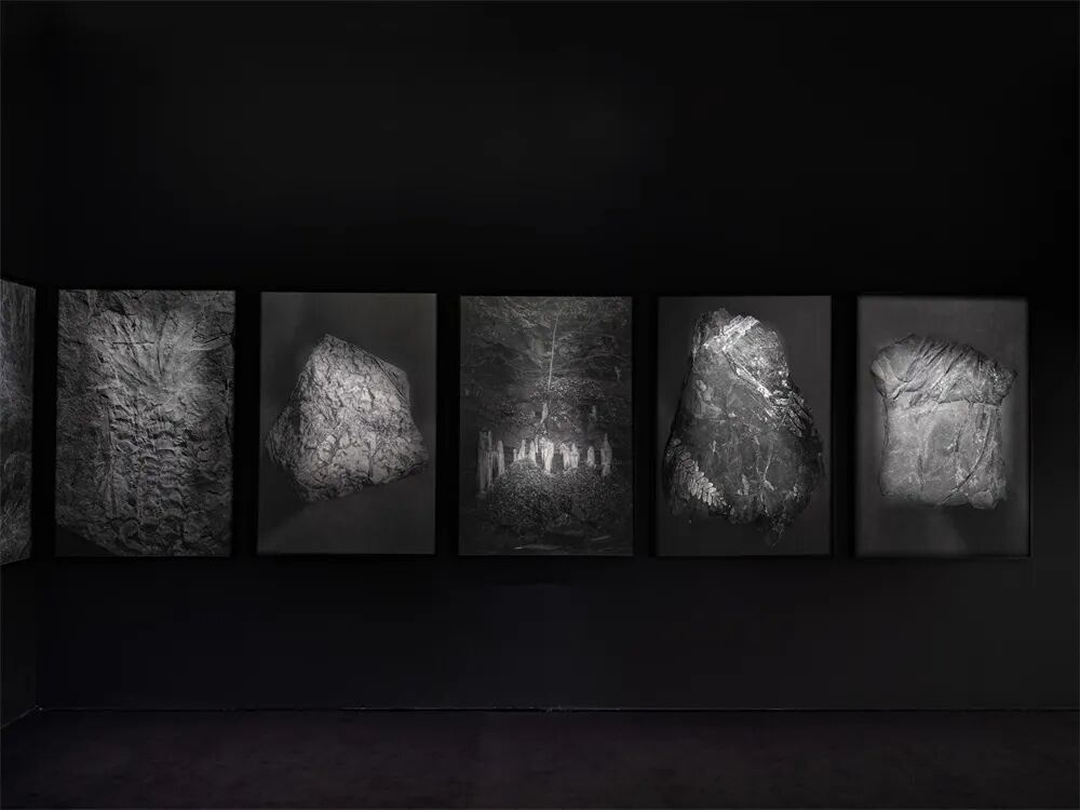
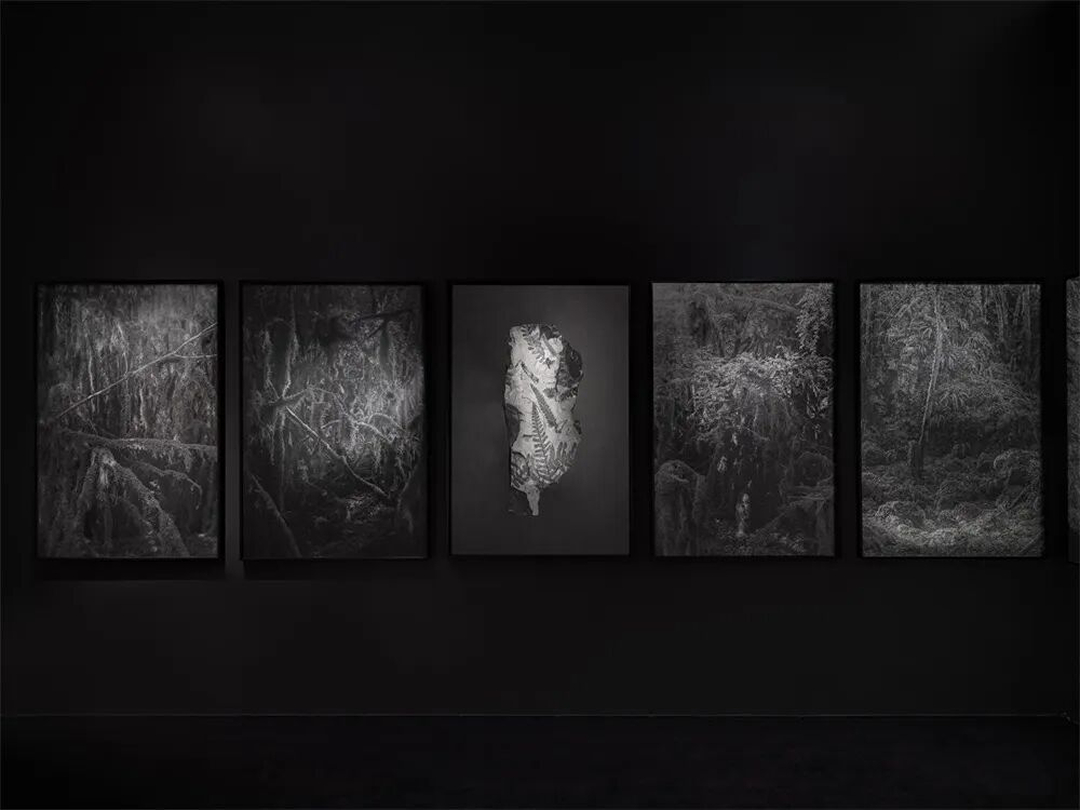
在石皮下生长的纯粹精神
阿梅莉·拉布尔代特
法国
摄影,独版,PIEZOGRAPHY打印(炭墨颜料墨水)
裱铝塑板
144.5cm x 97cm x 10
2021-2022
作品由艺术家提供
A Pure Spirit Grows Beneath theBark of Stones
Amelie Labourdette
FRA
Photography, unique edition, piezography print (carbonpigment inkl, mounted on aluminum composite panel144.5cm x 97cm x 10
2021-2022
Courtesy of the artist
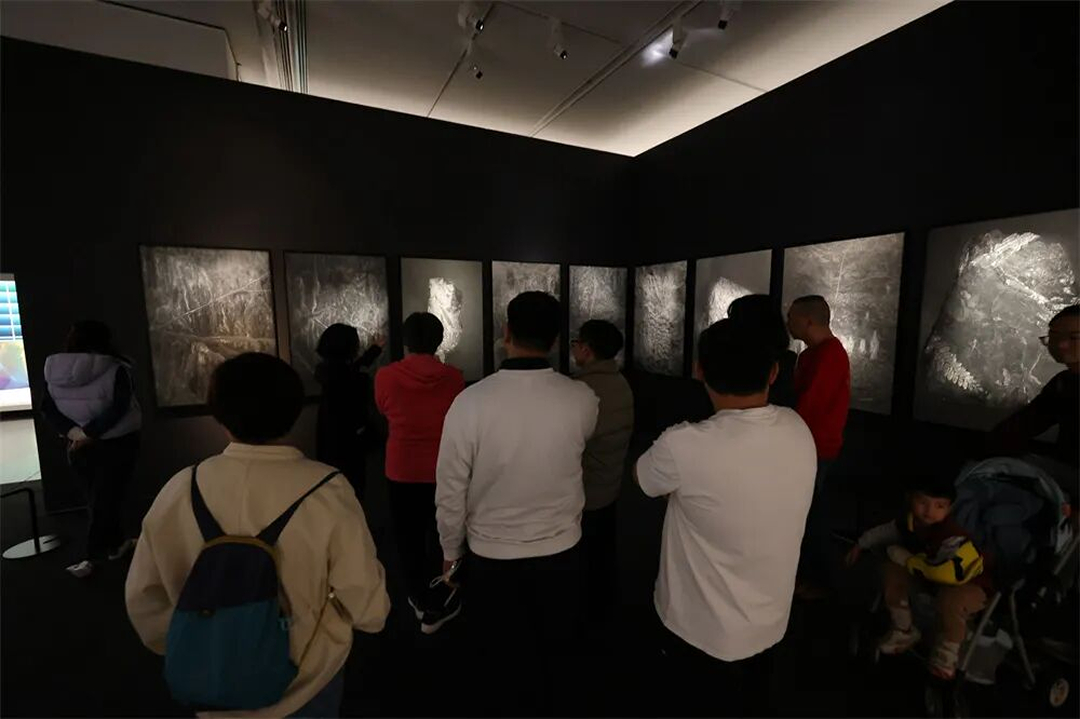
《在石皮之下生长的纯粹精神》系列呈现了阿梅莉·拉布尔代特(Amélie Labourdette)在纽约州奥尔巴尼市纽约州立博物馆(New York State Museum)开展的摄影研究成果。她在该馆古植物学收藏中的深入探索,使她得以拍摄吉尔博阿(Gilboa)与开罗(Cairo)地区发现的化石遗迹,这些遗迹属于中泥盆世(约3.85亿年前)地球上最古老的森林之一。与博物馆馆藏的考古探索并行,她亦在法国和美国多处当代森林中开展摄影创作,进一步拓展了研究的深度与维度。
该系列围绕两组影像展开,它们分别是对超越人类时间尺度的两类时态的摄影化呈现:一类承载着远古森林的祖先记忆,另一类则展现当代森林的跃动光谱。这两组图像彼此映照,相互激发。艺术家试图在自然的每一层面——包括植物性与矿物性之中——唤起一种“精神的在场”,从而质疑人类本体论上的优越性。这一创作也回应了当下关于“地球法理学”(Jurisprudence de la Terre)的讨论:即在一个“宇宙-政治体”(Cosmos-Politique)的框架中,非人类存在被视为政治与法律领域中的权利主体,并进入一个“扩展的议会”。
第一组图像揭示了地球最早森林的植物性记忆,这些记忆经由化石转化过程,由植物形态转为矿物结构,呈现为在卡茨基尔山区发现的化石碎片。根据古植物学中“泥盆植物假说”,这些早期森林生态系统对地球系统的动态演变产生了深远影响,包括土壤地貌的重塑、大气与气候的演变,以及地面生物多样性的扩展。如同幽灵再现,那些已矿化和炭化的原始森林幽影从遥远的过去浮现,今日重新回返,提醒我们:若无它们的存在,人类今日所栖之世界将无从诞生。
第二组图像则体现了一种化石般的震动,是“祖先精神”的存续,在今日森林的深处回响。将这份原初植物性记忆的震颤物质化,是一种与“世界之肉身”(chair du monde)亲密接触的经验。这一经验横贯不同森林空间,联结身体与精神,唤起对环境频率的感知与“内视之眼”的展开,使之通达有形与无形之间的界域。
科学研究显示,树木在电磁层面上具有活性,能够发射与接收信号,犹如天线般运作。它们吸收、传导并发射处于4至7赫兹之间的极低频电磁波。而地球本身也拥有可被测量的震动频率,即所谓的“舒曼共振”(Schumann Resonance),其基本频率为7.83赫兹。研究者指出,树木的电磁脉动与地核的地磁脉动同步,也与人脑的波动相关联。在森林之中,人类脑波会趋向与7.83赫兹的频率同步,从而进入一种变异意识状态——如冥想或创作状态(即θ波与α波所对应的脑电活动)。我相信,我已在直觉与意识的深处捕捉到了这种原初的震动频率——既源于我的内脏感知,也植根于精神的深层“内视”。正是这些震频,我试图在这组摄影作品中通过感性与视觉的方式加以表达。
作品所采用的碳基颜料墨水进行的日本纸皮佐印刷工艺(Piézographie),使图像呈现出一种既厚重又具有内发光感的物质性。这些作品令人联想到早期摄影实验者所尝试捕捉的“幽灵显现”。在作品墨色光泽的镜面闪烁与浓稠质感中,浮现出一种来自原始植物性记忆的震颤。毕竟,木炭正是森林有机物质部分分解的产物,是一种需历时百万年才能由植物转化为矿物的炼金过程。而这些由“死亡之身”——即原始森林的遗骸——所成的印刷物,其物质性本身便封存了它们的幽灵记忆。
《在石皮下生长的纯粹精神》由此被构想为一具记忆之身,也是一道振动的森林之体——由彼此交错的微妙层次所构成的记忆结构体。
“我以为,人当梦见大地,因其有心,亦在呼吸。”
——《坠落的天空:一位亚诺玛米萨满的言述》,达维·科佩纳瓦 著
A Pure Spirit Grows Beneath the Bark of Stones presents photographic works resulting from Amélie Labourdette’s research at the New York State Museum in Albany, New York. Her detailed exploration of the Paleobotany Collection enabled the photographic capture of fossil remnants from the oldest known forests on Earth, discovered in Gilboa and Cairo and dating back to the Middle Devonian period (385 million years ago). Alongside this investigation within the museum’s reserves, her research was further enriched by a photographic study carried out in the heart of several contemporary forests in France and the United States.
This series is structured around the interplay of two bodies of images, each representing the photographic materialization of a more-than-human temporality – one testifying to the ances tral memory of the primeval forest, the other revealing the vibrant spectre of contemporary forests – each reverberating within the other. It seeks to acknowledge an active spirit in every stratum of nature – here vegetal and mineral – that relativizes any ontological supremacy of humanity. It aligns with current research into Earth Jurisprudence, which calls for the extension of the political toward the cosmos-political, recognizing non-human entities as Subjects of rights within political and legal spheres in an “expanded parliament.”
The first corpus unveils the imprint of the vegetal memory of the oldest forest on Earth, dating from the Middle Devonian, transmuted from vegetal to mineral within fossil fragments found in the Catskills. According to the Devonian Plant Hypothesis developed in paleobotany, the afforestation of the Earth by these earliest forest ecosystems had considerable consequences on the dynamics of the Earth system, including the transformation of soil geomorphology, the evolution of the atmosphere and climate, and the concurrent expansion of terrestrial biodiversity. Like revenants, the mineralized and carbonized spectres of primordial forests emerge from the depths of the past and return to haunt us today, reminding us that the world in which we humans live could not have existed without their presence.
The second corpus embodies a fossil vibration, a survivance of an “ancestral spirit” manifesting in the heart of today’s forests. To materialize the vibration of this original vegetal memory is consubstantial with the experience of the “flesh of the world”2 lived within various forests: an experience that connects body and spirit, sensitivity to the vibratory frequencies of places and visions – an inner eye – open to both the tangible and the intangible.
Trees are electromagnetically active, emitting and receiving signals. They can act as antennas.They capture, absorb, and emit ultra-low frequency electromagnetic waves between 4 and 7 Hertz. The Earth itself possesses a measurable vibratory frequency, known as the Schumann resonance, with a fundamental frequency of 7.83 Hz. Researchers have found that the electro magnetic pulsations of trees synchronize with the geomagnetic pulses of the Earth’s core and correlate with human brainwaves. In the presence of trees, as in forests, human brainwaves synchronize with the 7.83 Hz frequency, producing a modified state of consciousness, a meditative or creative state corresponding to theta and alpha brainwaves. I believe I have intuitively grasped this original vibratory frequency, both in my gut and in the depths of my mind – innervision. These are the frequencies I have attempted to translate in a sensitive and visual manner in this photographic work.
The Piezography printing process on Japanese paper – using inks composed of charcoal-black pigments – gives the photographic material a presence that is both dense and radiant. These prints evoke the experiments of early photographers who, in some cases, sought to record “spectral apparitions.” In the iridescent shimmer and density of the carbon-based inks, the vibration of an archaic vegetal memory emerges. Is not charcoal the result of the partial decomposition of the organic matter of primeval forests, an alchemical transformation that takes millions of years to transition from vegetal to mineral? The very materiality of these prints, made with the transmuted dead body of these original forests, encloses their spectral memory.
A Pure Spirit Grows Beneath the Bark of Stones is thus conceived as the memorial and vibrant body, of subtly intertwined layers, of the forest.
«I think you should dream the earth, because it has a heart and it breathes»
The Falling Sky – Words of a Yanomami Shaman, by Davi Kopenawa
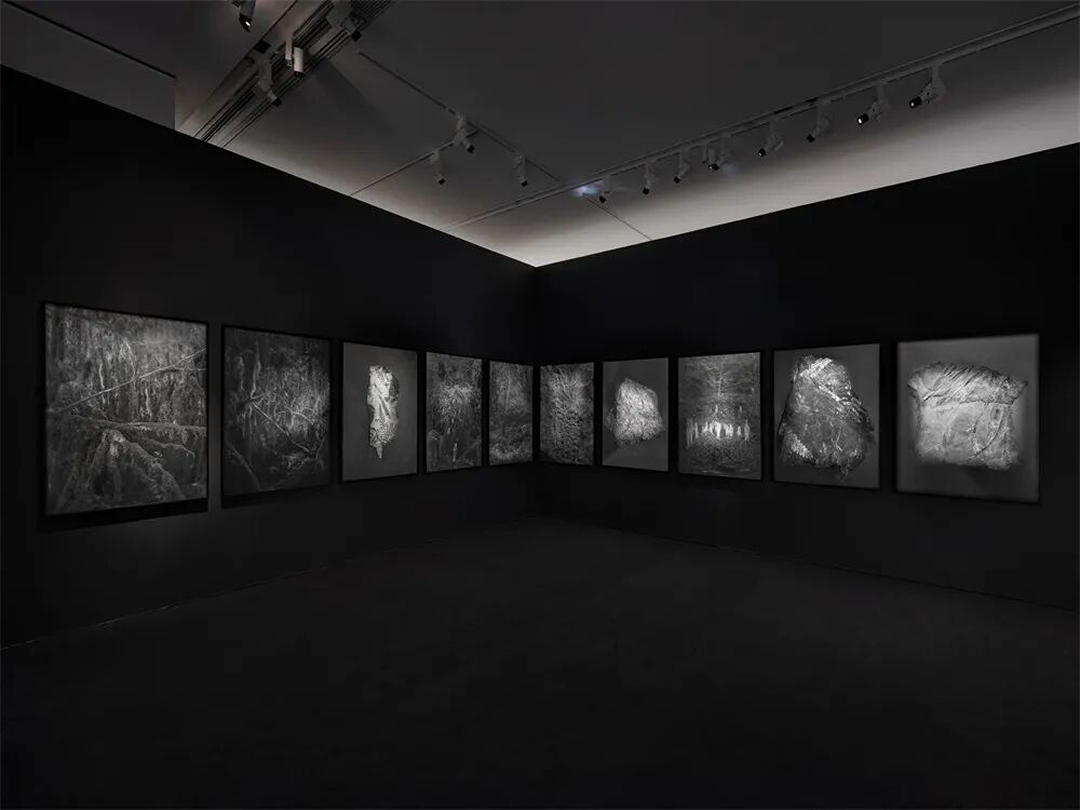
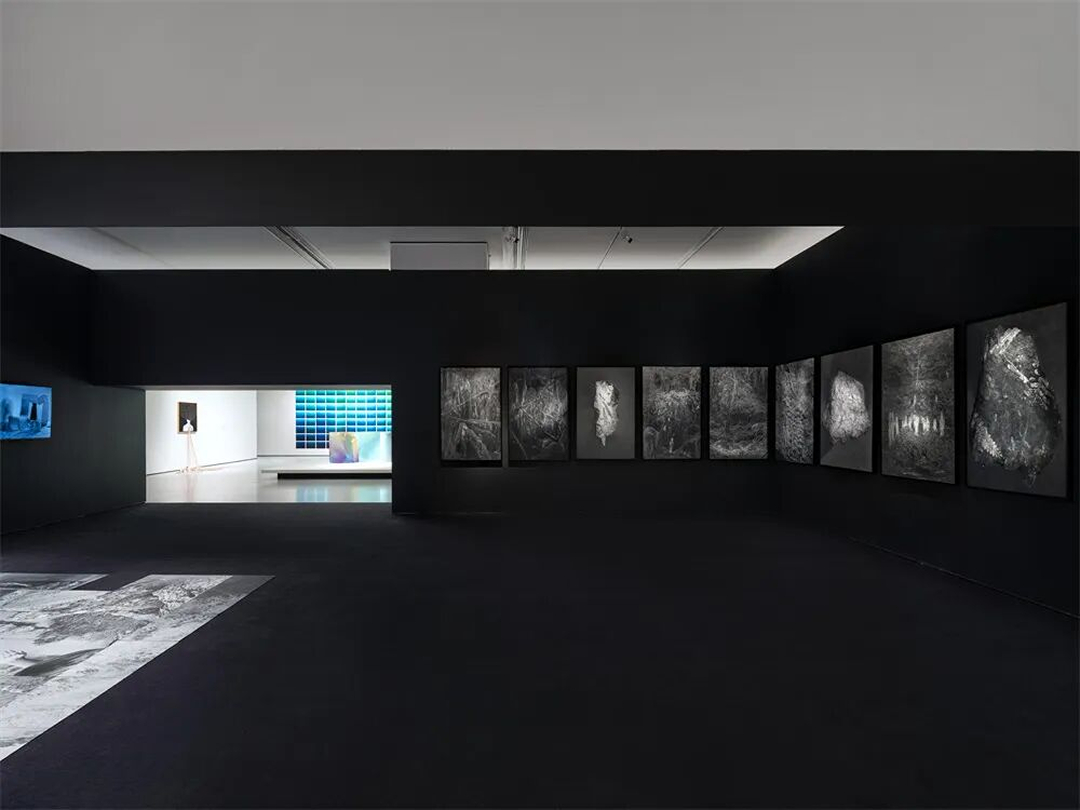
展览现场
审定 / 涂晓庞
审校 / 曾睿洁
资料提供 / 石裕榕
图片 / 曾雨林 杜悦儿
编辑 / 刘丹妮


开放时间——每周二至周日9:00至17:00(16:30停止入场,16:45开始清场)
逢周一闭馆(法定节假日和特殊情况除外)。
广东美术馆新馆(白鹅潭):广东省广州市荔湾区白鹅潭南路19号
前台电话: (020) 88902999
广东美术馆本馆(二沙岛):广东省广州市越秀区二沙岛烟雨路38号
前台电话: (020) 87351468