

SO LONG,SO PROFOUND Huang Yongyu's New Paintings
Hall 1-3, 1F, Guangdong Museum of Art (BAIETAN)
2025-12-09——
2026-03-15
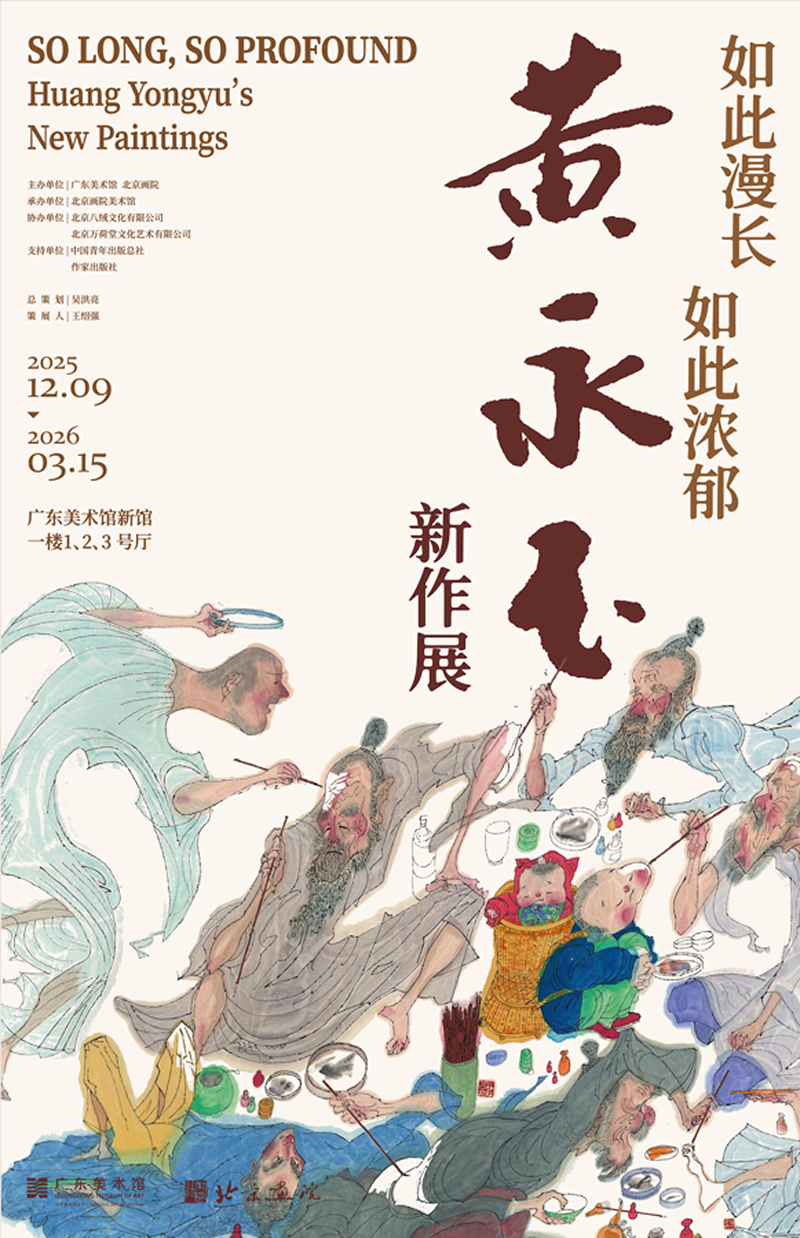
Date: 2025.12.09-2026.3.15
Venue: Hall 1-3, 1F, Guangdong Museum of Art (BAIETAN)
(Address: No. 19, Bai'etan S. Rd., Liwan District, Guangzhou)
Organizers:Guangdong Museum of Art, Beijing Fine Art Academy
Supporting Organizer:Art Museum of Beijing Fine Art Academy
Co-organizers:Beijing Barong Culture Co., Ltd, Beijing Wanhetang Culture and Art Co., Ltd
Support Units:China Youth Publishing Group, The Writers Publishing House
General Supervisor:Wu Hongliang
Curator::Wang Shaoqiang
Introduction
In 1999, Huang Yongyu traveled to Guangzhou to personally prepare for the millennial exhibition “Huang Yongyu: Art Across the Century” at the museum’s Ersha Island location. During his eleven-day stay, he created thirteen sculptures specifically for the exhibition—including the Self-Portrait, now kept at his Wanhetang studio. His fervor for creation was unforgettable.
Twenty-six years later, Huang’s art returns to the Guangdong Museum of Art in the exhibition “So Long, So Profound— Huang Yongyu’s New Paintings.” This exhibition presents nearly one hundred and fifty works by the artist created after the age ninety. Structured in three chapters and guided by the flowing inscriptions that run across his works, it offers both the distinctive “Huang-style humor” and profound thought. The chapter “Free Wandering” reveals his conversation with Daoist philosophy; “Laughing with an Open Mouth” brims with innocence, warmth, and irreverent delight; “One Hundred Thousand Wild Blossoms, Like a Dream” reflects on belonging, time, and the passage of life. Through his nearly century-long life, Huang transformed hardship into humor, speaking of the human condition through bold lines and mischievous prose—always revealing a soul free, bright, and endlessly alive. We warmly invite visitors to enter Huang Yongyu’s world—free, humorous, and richly colored—and to experience through these works the passion with which he lived, and the joy with which he created.
Selected Works
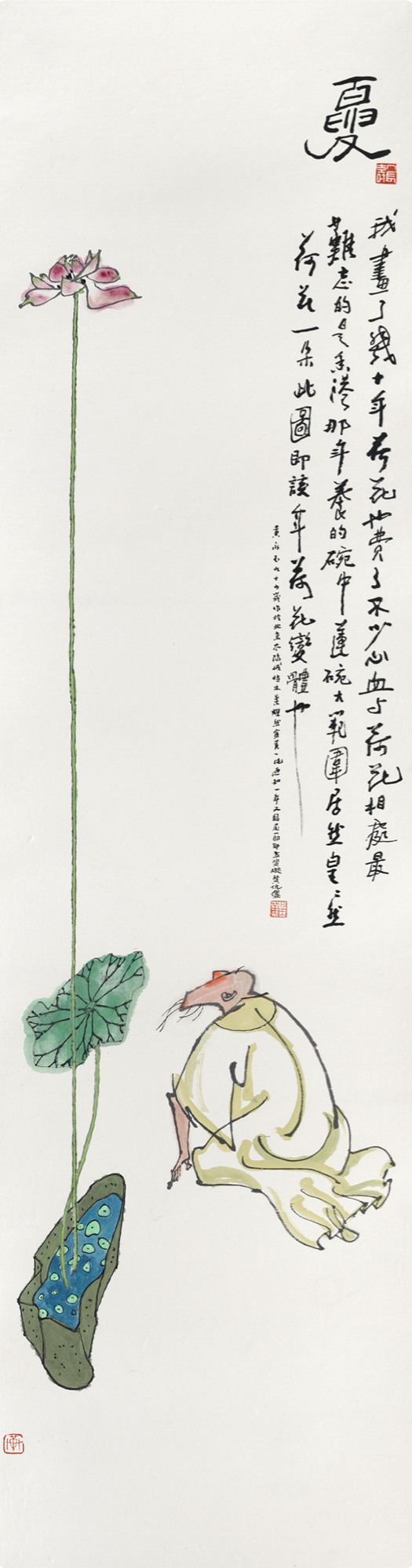
Summer
Huang Yongyu
Color on paper
48cm x 179cm
2017
Inscriptions:
Summer
I have painted lotus flowers for decades and spent a great deal of effort living with them. The most unforgettable was the lotus grown in a bowl in Hong Kong that year. Though the bowl was small, the lotus bloomed magnificently. This painting is a variation of the lotus from that year.
Created by Huang Yongyu at age 94 in Sun City, Beijing.
As the leaves turn a brilliant golden yellow, one realizes the year is reaching its end.
For Mr. and Mrs. Martin Posth.
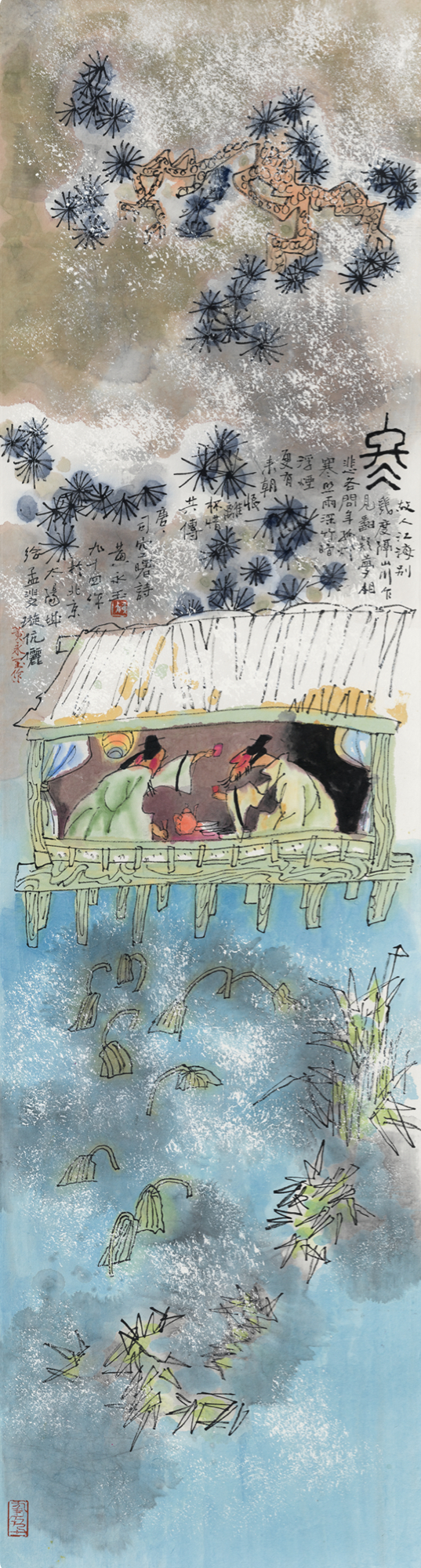
Winter
Huang Yongyu
Color on paper
48cm x 179cm
2017
Inscriptions:
Winter
An old friend departs by the rivers and seas, separated by mountains and streams for years. A sudden meeting feels like a dream; in sorrow, we ask each other's age. A lonely lamp coldly illuminates the rain; deep bamboo drifts in dark mist. More bitter is the parting of tomorrow morning; we cherish the final cups shared. — Poem by Sikong Shu (Tang Dynasty).
Huang Yongyu at age 94 in Sun City, Beijing.
For Mr. and Mrs. Martin Posth.
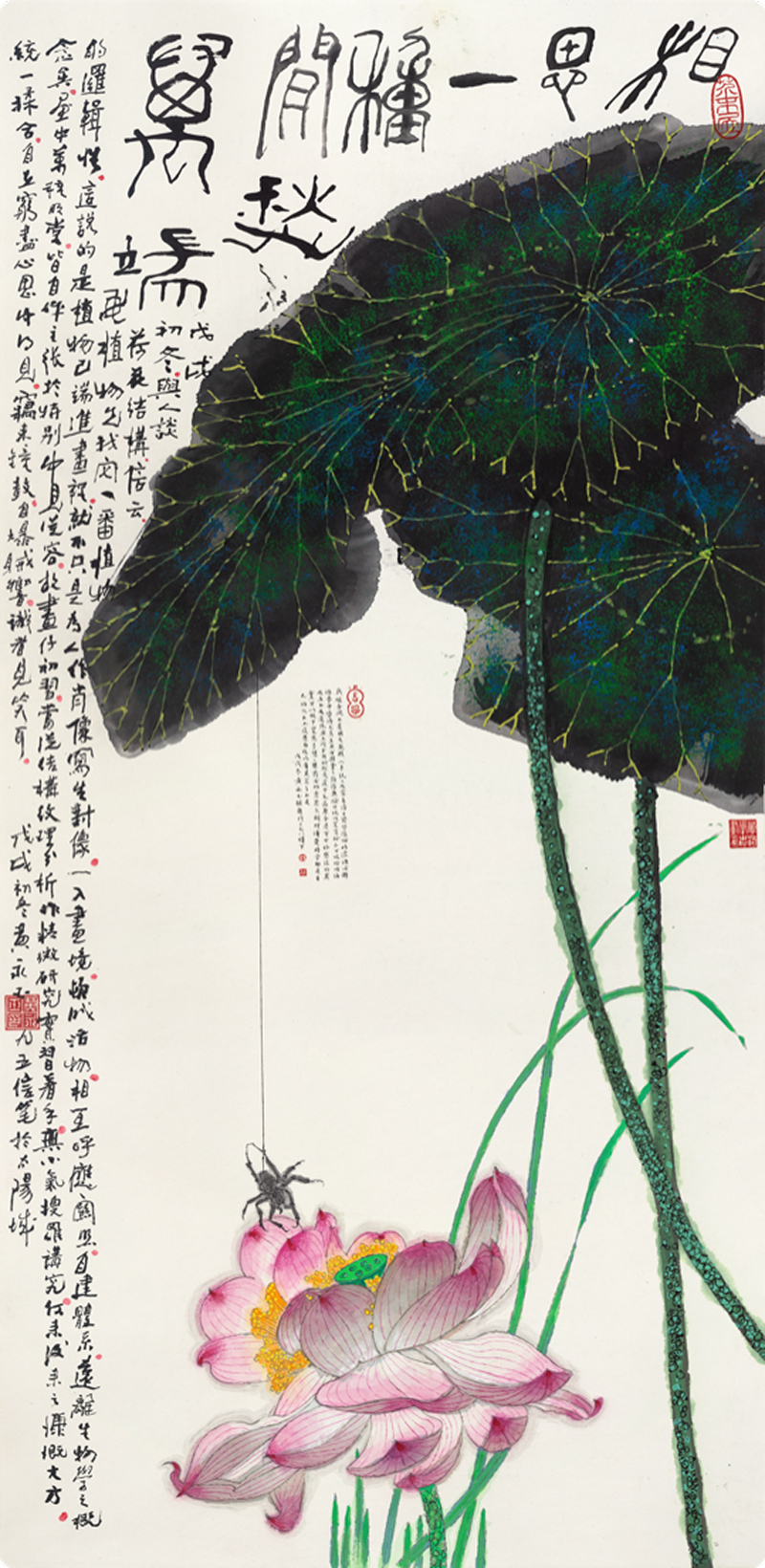
A Kind of Yearning, Myriad Idle Sorrows
Huang Yongyu
Color on paper
48cm x 179cm
2017
Inscriptions:
A Kind of Yearning, Myriad Idle Sorrows
Early winter of the Wuxu year, discussing the structure of the lotus. Notes: When drawing plants, first find the "logic of the plant." This means once a plant enters a painting, it is no longer just a portrait. Once a live subject enters the artistic realm, it becomes a living entity. Echoing and caring for one another, they build their own system, distancing themselves from biological concepts. The various "names and styles" in a painting are all self-determined to show leisure amidst the unique. Therefore, young painters should start by studying structural textures and fine details. Without meticulous gathering and refinement, how can there be future generosity and boldness? Unified harmony is found through exhaustive thought. Like a thief stealing bells and drums only to set them off with a loud bang, those who know will surely laugh.
Early winter of the Wuxu year, Huang Yongyu writing casually in Sun City.
I don't need friends to wake me up. As one gets older, it's easy to spout opinions—like drunken words or sleep-talking. Especially in the excitement after finishing a painting, I let the brush run wild incoherently; it becomes irrepressible, and regret comes too late. What is written on this painting suffers from this very ailment. I originally had a good idea, but I should have put down the brush and thought more about the meaning, organizing it clearly first. Time and space are my own; there was no need for such a rush. You see it and laugh, don't you?
Winter of the Wuxu year, Huang Yongyu adding notes downstairs at Building 378.
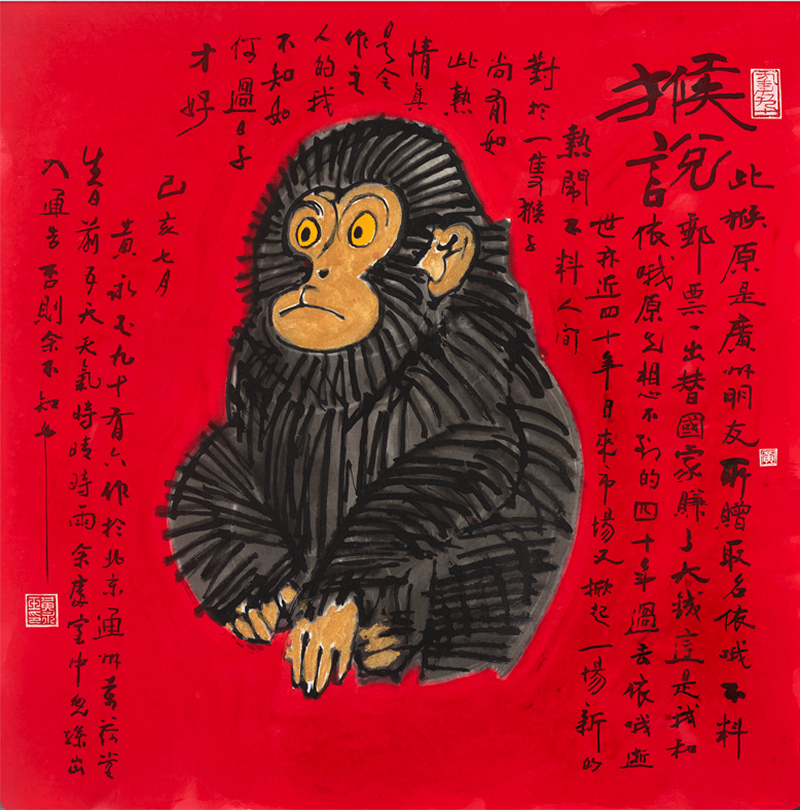
Monkey Says
Huang Yongyu
Color on paper
68.6cm x 68.6cm
2019
Inscriptions:
Monkey Says
This monkey was originally a gift from a friend in Guangzhou, named "Yi-O." Unexpectedly, once the stamp was issued, it earned a fortune for the country—something Yi-O and I never anticipated. Forty years have passed, and it has been nearly forty years since Yi-O's passing. Recently, the market has kicked up a new fuss; I didn't expect the world to still have such passion for a monkey. It truly leaves me, the owner, not knowing how to go about my days.
July of the Jihai year.
Huang Yongyu at age 96 in Wanhetang, Tongzhou, Beijing.
Five days before my birthday, the weather alternates between rain and shine. I stay indoors, and unless my children and grandchildren announce it, I wouldn't know.
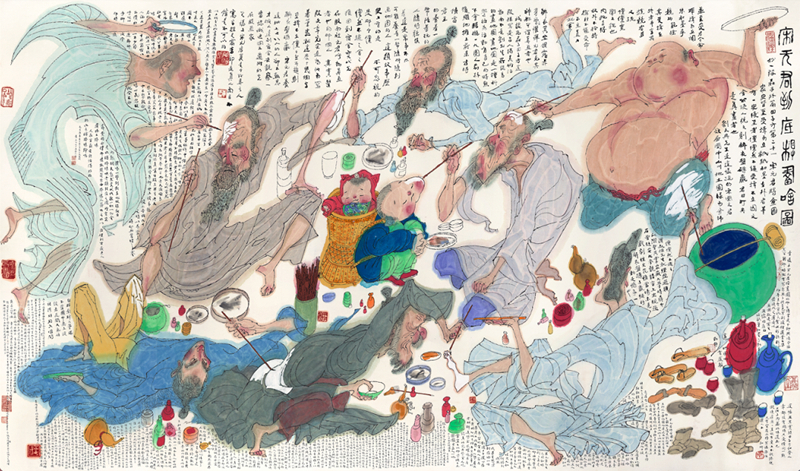
What Map Did Duke Yuan of Song Want to Paint After All?
Huang Yongyu
Color on paper
143.5cm x 243.5cm
2020
Inscriptions: (Excerpt)
...Writing these nonsense words is just for a bit of willful joy. Talking about the joy of life, there are only a few kinds: that of humans and beasts, of the cultured and the uncultured, of organs and machines, of humanity and animality, of cruelty and abuse, of rewards and flattery, of the serious and the makeshift, of the elephant and the flea...
I think of an old friend, Liu Huozi, a Cantonese and a senior in journalism. His wife, Jin Duanlin, was a great expert in cartography. I once had an "Atlas of World War II Progress"—a thick volume with striking colors that shocked the heart and mind, utterly unforgettable; that was her work. Her brother was Jin Zhonghua, a great expert in international affairs. Mapping is a precise scientific discipline that requires comprehensive artistic skill. Think of the technological conditions then—an era where one had to measure the world's land area kilometer by kilometer. At that time, their home was on the third floor of Ferry Street, Jordan Road, Kowloon, Hong Kong. I only remember that glowing, gridded workbench. Mentioning these things is just a struggle to add some rational context. Even if what Duke Yuan of Song wanted was truly a map, there was no need to rush so much, was there? I've lost myself a bit. ...
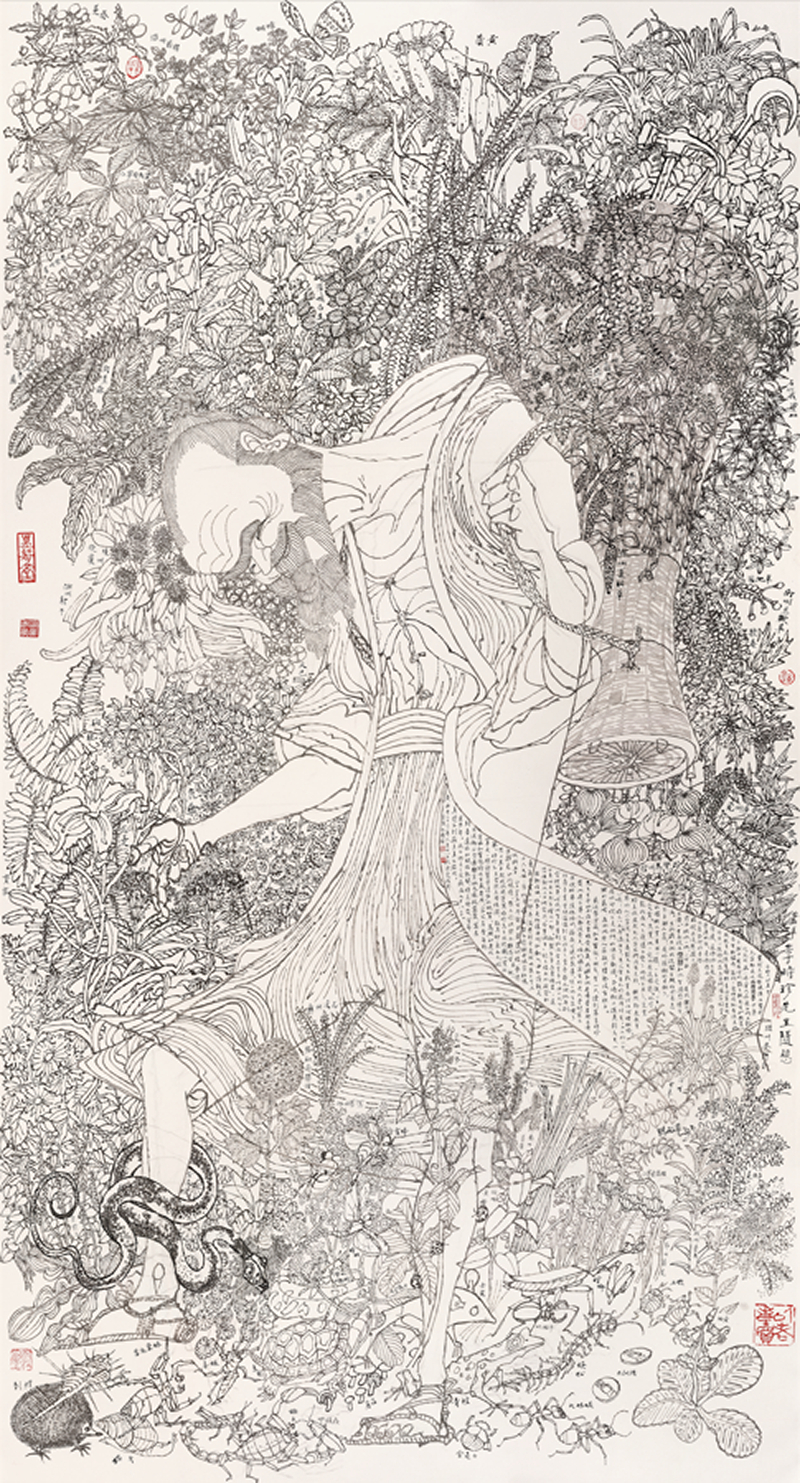
Reflections on Mr. Li Shizhen
Color on paper
179cm x 97cm
2021
Inscriptions:
Reflections on Mr. Li Shizhen
When I was young, I only knew about Chinese medicine; I had never heard of Western medicine. The elderly all died after taking Chinese medicine. When I was gravely ill as a child, it was the Chinese doctor Liu Ziyou at the West Gate who saved me. Mr. Liu Ziyou had some connection with the Education Bureau; from time to time, I would see him leaning against the wall, walking home drunk from the Bureau. It was a long walk. His home was next to the Chen Family Ancestral Hall at the West Gate. This road wasn't just ordinary long; it was a very long, helpless road of suffering. I never thought to go forward and support him. On one hand, I lacked the strength; on the other, I had never had an emotional exchange with him. He pulled me back from the brink of death—why didn't I thank him more? Yes, the thanks that were due were given long ago, like buying things on the street: money in one hand, goods in the other. Actually, he must have thought the same. Perhaps my appearance changed as I grew up and he couldn't recognize me. In reality, the adults didn't socialize, though they were both in the education sector. Alas! Eighty or ninety years have passed. My late father had his own friends, yet in a small county town, I never saw them sharing a glass of wine. When meeting Mr. Liu on the street, his face was so stern I didn't even have the courage to salute him.
Recently, I have been ill often and have become friends with Western medicine. One day, I read a biographical article about Mr. Li Shizhen and benefited greatly. Although I knew he was a polymath, I didn't know he hadn't even passed the provincial civil service exam. Our country has many great scholars who did not follow the path of the imperial examinations. With the guidance of his grandfather and father, he studied hard at home for several years. His scholarship overflowed all the way to the capital, and the Emperor brought him into the palace to work. I heard he had the honor of seeing the "Essentials of the Imperial Pharmacopoeia," which Emperor Xiaozong of Hongzhi had forty-nine people hand-paint in less than a year. This probably provided great inspiration and momentum for his later research on the "Compendium of Materia Medica." The story is so winding and moving that I plucked up the courage to buy a copy. I didn't expect it to weigh dozens of pounds—thirty-six large volumes, in their original form. I cannot but thank our ancestors and modern science. A magnificent masterpiece from five hundred years ago is laid out before my eyes; such a scale is rarely seen even in dreams. For several days, I could hardly sleep for joy. From a certain day, I picked up paper and brush to write "Mr. Shizhen on Inspection" to celebrate this. I have never met Mr. Shizhen, of course; I only take his spirit—it is a sort of congratulation on medical progress. I am happy to know that Peking Union Medical College Hospital will celebrate its centenary. When my father was young, every time he returned home, he would talk about the grand sights of the capital, Shanghai, and Hangzhou; on one occasion, he joyfully spoke of the bustling opening of PUMC. Time flies; a century is but a repeat of steps. In a month or so, I will be ninety-eight. I truly didn't realize that years were so quickly spent.
Huang Yongyu, June 28, 2021
This painting was completed at Wanhetang, East Beijing.
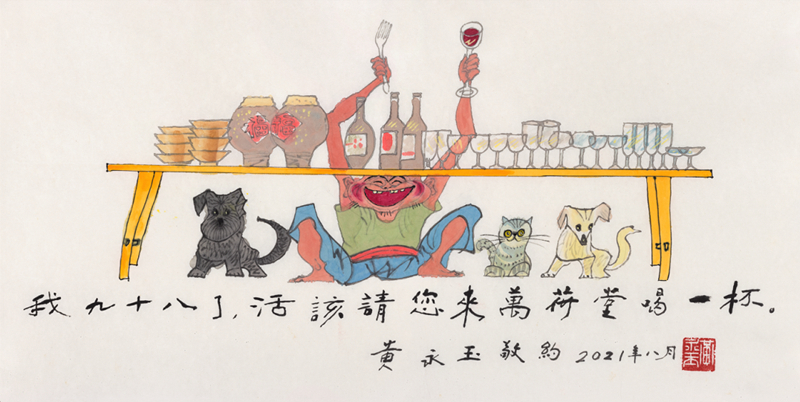
98th Birthday Card
Huang Yongyu
Color on paper
25cm x 13cm
2022
Inscriptions: I am ninety-eight; it is only right to invite you to Wanhetang for a drink.
Warmly invited by Huang Yongyu, August 2021
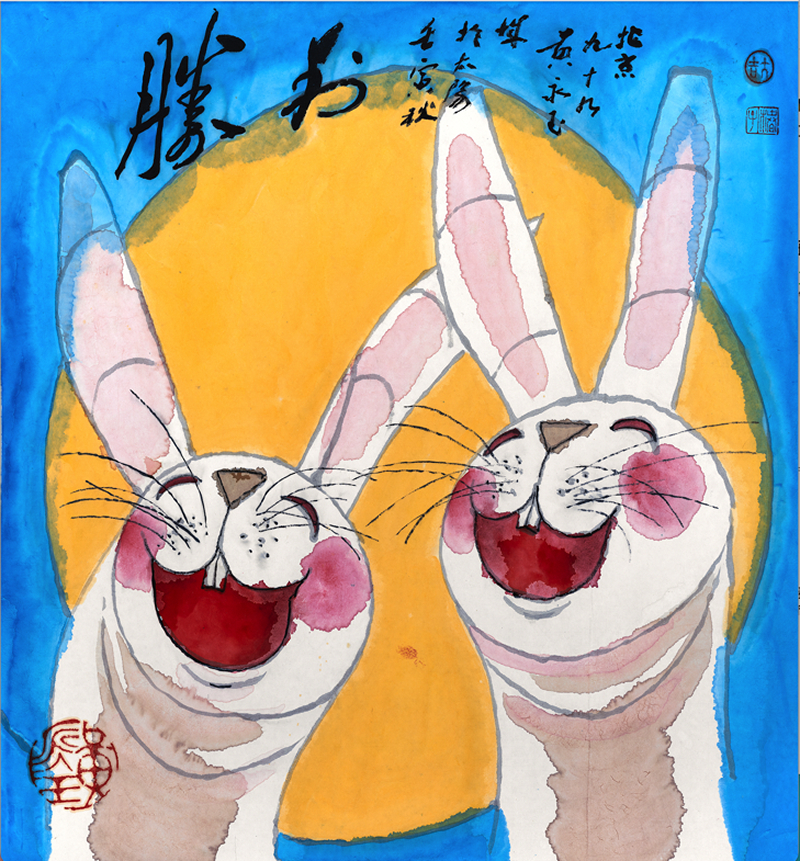
Victory
Huang Yongyu
Color on paper
48cm x 45cm
2022
Inscriptions:
Victory
Autumn of the Renyin year in Sun City, Huang Yongyu at ninety-nine, Beijing.
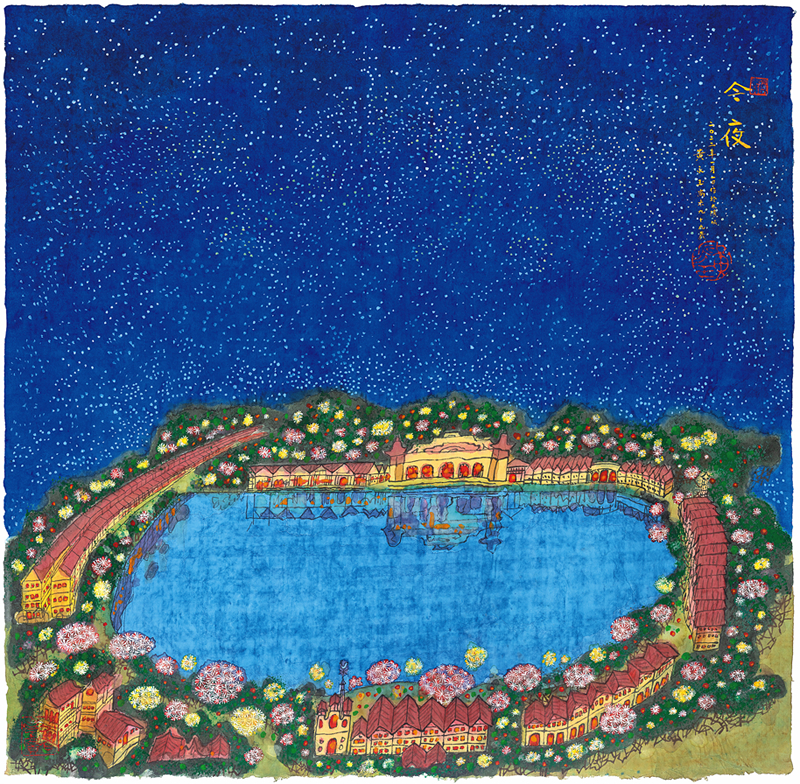
Tonight
Huang Yongyu
Color on paper
125cm x 125cm
2022
Inscriptions:
Tonight
Created on January 1, 2022, in Sun City.
Huang Yongyu is not yet ninety-nine years old.
About Artist
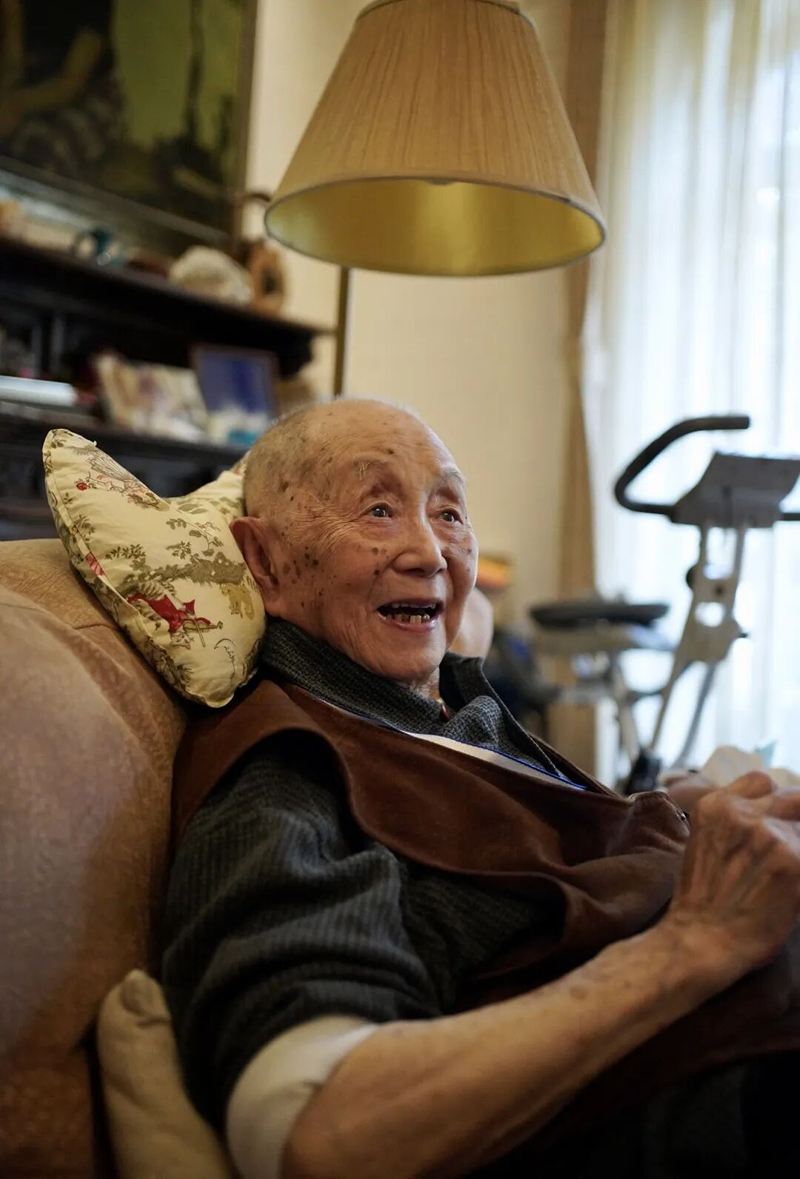 Huang Yongyu
Huang Yongyu (1924—2023) was born in Changde County, Hunan Province (now Dingcheng District, Changde City), with ancestral roots in Fenghuang County, Hunan. He was of the Tujia ethnicity. He served as the Director of the Printmaking Department at the Central Academy of Fine Arts, President of the Printmaking Academy of the China National Academy of Painting, and Vice Chairman of the China Artists Association. Huang Yongyu was proficient in woodcutting, painting, and literature, creating a vast number of artistic works throughout his life. Mr. Huang Yongyu is renowned worldwide for his frank and open nature and his creative vision that spans traditional Chinese painting, printmaking, and literature. Having experienced many storms in his life, he always maintained a childlike innocence and freedom. Huang viewed creation as the pinnacle of self-expression, stating bluntly, "A painter paints how they want to paint," without being bound by academic dogma or traditional ruts, nor catering to popular trends. His brushwork moved with his emotions, governing complexity with simplicity, revealing a profound understanding of the essence of art through seemingly casual strokes—the work is the truest projection of the inner self. Whether it was allegorical animals or the trivialities of daily life under his pen, all were endowed with vivid life and philosophy. In his later years, he still considered himself a "post-90s" (someone born in the 90s, jokingly referring to his age), living with an increasingly free and easy spirit.
We cordially invite you
To the New Venue of the Guangdong Museum of Art
On December 9, 2025, at 2:30 PM
To attend the Opening Event of
“So Long, So Profound”
Huang Yongyu's New Paintings Exhibition
We look forward to your presence!
Approved by / Tu Xiaopang
Reviewed by / Zeng Ruijie
Edited by / Yu Shuya
Opening hours: every Tuesday to Sunday from 9:00 to 17: 00 (admission is closed at 16: 30 and clearance is started at 16:45).
Closed on Mondays (except legal holidays and special circumstances).
Baietan Area: No. 19, Baietan South Road, Liwan District,Guangzhou P.C. 510170 | Front Desk Phone:020-88902999,020-88902888
Ersha Island: No. 38 Yanyu Road, Ersha Island, Yuexiu District, Guangzhou P.C. 510105 | Front Desk Phone:020-87351468
Closed on Mondays (except legal holidays and special circumstances).
Baietan Area: No. 19, Baietan South Road, Liwan District,Guangzhou P.C. 510170 | Front Desk Phone:020-88902999,020-88902888
Ersha Island: No. 38 Yanyu Road, Ersha Island, Yuexiu District, Guangzhou P.C. 510105 | Front Desk Phone:020-87351468